
If you sit on an HOA board anywhere in Salt Lake County or Davis County, you already know the math: a community with thousands of square feet of common-area grass is a community writing a very large check to the water utility every July and August. And this year, that check is going to be even bigger.
The 2025/2026 winter was one of the driest on record for the Wasatch Front. Reservoir levels heading into summer are well below the seasonal average, and municipalities across the Salt Lake Valley and Davis County have signaled that restrictions — and rate increases — are on the horizon. The HOAs and commercial properties that plan now are the ones that protect their budgets and their curb appeal later.
Whether you manage a residential community in South Jordan, a commercial campus in Layton, or an HOA in Bountiful or Midvale, these are the five most effective strategies to dramatically reduce water consumption, lower maintenance costs, and keep your common areas looking sharp all season long.
Walk your HOA’s common areas and ask one simple question about each section of grass: does anyone actually use this? Strip-style patches along parking lots, narrow buffers between sidewalks, and decorative corners that no resident ever sets foot on are all prime candidates for conversion. These areas exist purely to look green — and they demand full irrigation to do it.
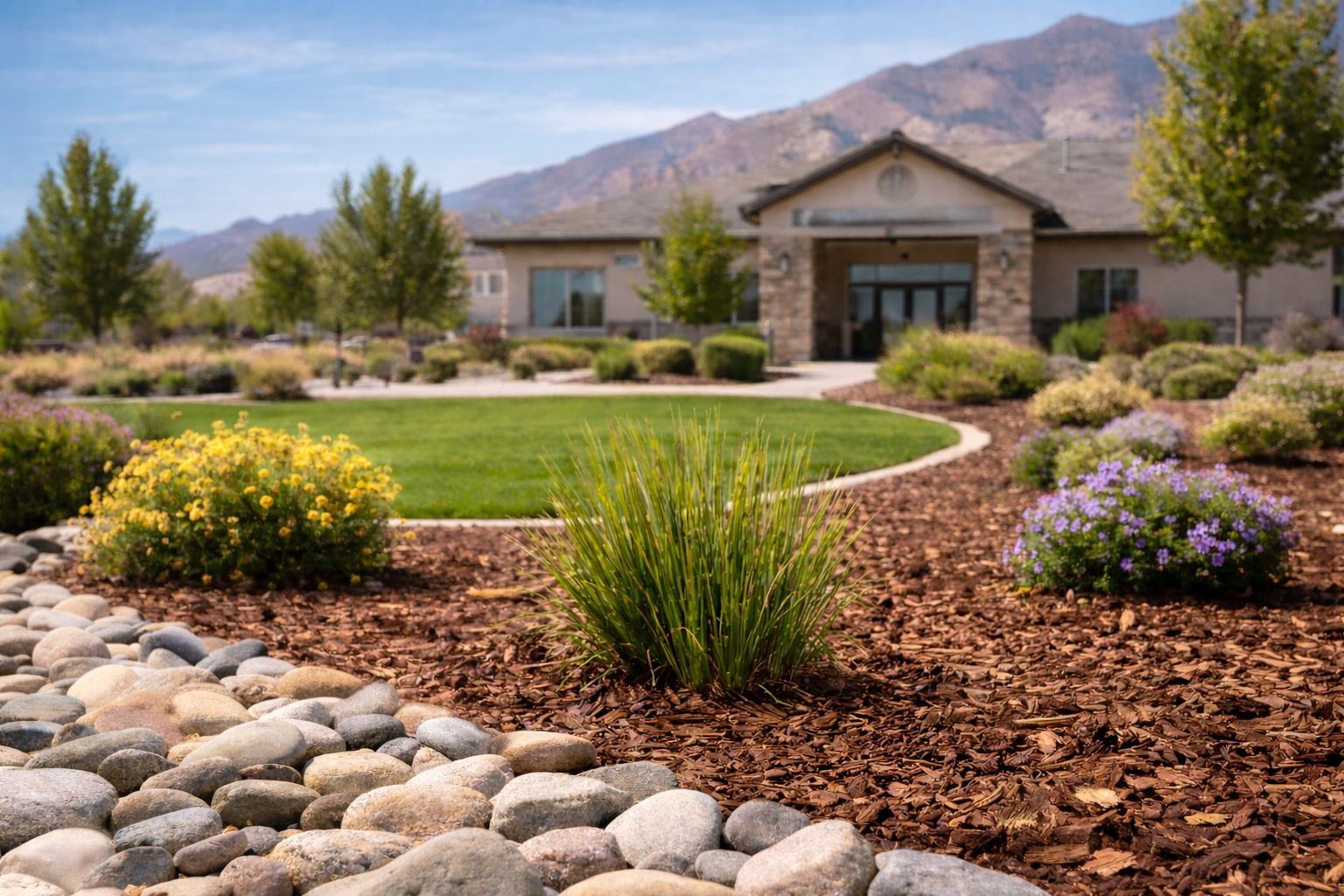
Replacing non-functional turf with decorative rock or a thick layer of bark mulch eliminates the need to water those zones entirely. Combined with a commercial-grade weed barrier installed beneath the surface, the ongoing maintenance burden drops significantly. Studies from Utah water agencies indicate that converting irrigated turf to rock or mulch landscaping can reduce water use in those areas by 50 to 70 percent.
The visual result isn’t barren. River rock, crushed gravel, and rich dark mulch create clean, deliberate aesthetics that actually elevate curb appeal compared to patchy, drought-stressed summer grass. For HOAs across Salt Lake and Davis counties, this is one of the highest-impact changes you can make before the peak irrigation season begins.
Traditional spray heads and rotors broadcast water indiscriminately — much of it evaporates, drifts in the wind, or soaks areas with no plants in them. Drip irrigation delivers water directly to the root zone of each individual plant, eliminating waste almost entirely. For HOAs with shrub beds, ornamental trees, perennial borders, or entry monument plantings, converting those zones from spray to drip is one of the highest-ROI upgrades you can make to your irrigation system.
Drip systems also pair perfectly with mulched beds. The mulch holds moisture in the soil longer, so the system runs less frequently to maintain the same plant health. It’s a compounding advantage: less water in, more plant vitality out.
For larger HOA properties and commercial campuses throughout the Salt Lake Valley and Davis County, drip conversions on ornamental zones frequently pay for themselves within a single irrigation season through water bill savings alone.
The thirstiest plants in most HOA landscapes are the ones that don’t belong here. Kentucky Bluegrass, tropical annuals, and non-native flowering shrubs all require high-water inputs to survive what is already the second-driest state in the nation — and a particularly dry year on top of that.
Native Utah plants — blue grama grass, rabbitbrush, penstemon, Apache plume, and ornamental sage — evolved to thrive on the amount of water this state actually receives. They’re adapted to our alkaline soils, our temperature swings, and our periodic drought cycles. They require far less fertilizer, resist the pest pressures that constantly target thirsty ornamentals, and attract beneficial pollinators that keep the landscape healthy.
A well-designed native planting doesn’t look sparse or neglected. When paired with decorative rock and professional installation, the result is a striking, modern aesthetic that signals forward-thinking property management — exactly what HOA homeowners and commercial tenants across Salt Lake and Davis counties expect to see.
One of the most overlooked water-saving upgrades an HOA can make is also one of the simplest: a smart irrigation controller. Standard mechanical timers run their pre-set schedules regardless of what the weather is doing — they’ll run full cycles the day after a rainstorm, or during a cool overcast stretch when no irrigation is needed at all.
Smart controllers connect to local weather data and adjust run times automatically based on actual evapotranspiration rates. For larger HOA properties with dozens of irrigation zones — common across planned communities in Herriman, Eagle Mountain, Farmington, and Syracuse — the water savings from a smart controller frequently pay for the hardware within a single season.
Pair the controller upgrade with a professional irrigation audit. You may discover overlapping spray patterns, broken heads running unnoticed for weeks, or zones programmed to water at peak evaporation hours rather than early morning. Fixing these inefficiencies alone can produce immediate, measurable reductions on your utility bill.
Mulch is one of the most hardworking, cost-effective materials in landscape management — and it’s chronically under-applied in HOA settings. A three-to-four inch layer of quality bark mulch around the base of trees and throughout shrub beds does three things at once: it blocks the intense Utah sun from baking and cracking the soil, it dramatically reduces evaporation from the root zone, and it moderates soil temperature so roots stay healthy through summer heat spikes.
In a dry year like this one, mulch is genuinely the best insurance policy you can buy for your mature, established landscape plants. It means your irrigation system doesn’t have to work as hard to maintain the same moisture levels — and that directly translates to lower water usage and lower bills.
Plan for fresh mulch installation in early spring, before the heat arrives, so it’s protecting your soil from day one of the irrigation season. For HOAs managing large common areas across Salt Lake and Davis counties, coordinating mulch replenishment as part of your spring maintenance contract is the most cost-efficient way to get it done consistently.
Each of these strategies sounds straightforward, but the details matter. Converting turf properly requires full removal, soil grading, and correct weed barrier installation — not just gravel dumped on top of existing grass. Drip systems need to be engineered for the specific flow rates, pressure, and coverage of each zone. These are not DIY projects for HOA boards working with volunteers on a Saturday morning.
A professional installation done right the first time is what delivers lasting water savings, the clean visual result that protects property values, and the reduced maintenance burden that frees up your HOA’s operating budget for other priorities.
Denkers Property Maintenance has been helping HOAs, commercial properties, and residential clients across Salt Lake County and Davis County adapt to Utah’s high-desert climate for over 40 years. We specialize in large-scale common-area transformations, irrigation upgrades, turf conversions, and full landscape redesigns built to perform through the toughest Utah summers.
Whether you manage a planned community in South Jordan, a commercial property in Bountiful, or a large HOA campus anywhere in the Salt Lake Valley — our crews have the local expertise, the equipment, and the experience to get it done right.
Text or call us today at 801-484-8389 to schedule a custom property evaluation. Let’s build a landscape that conserves water, reduces your costs, and looks great doing it.