
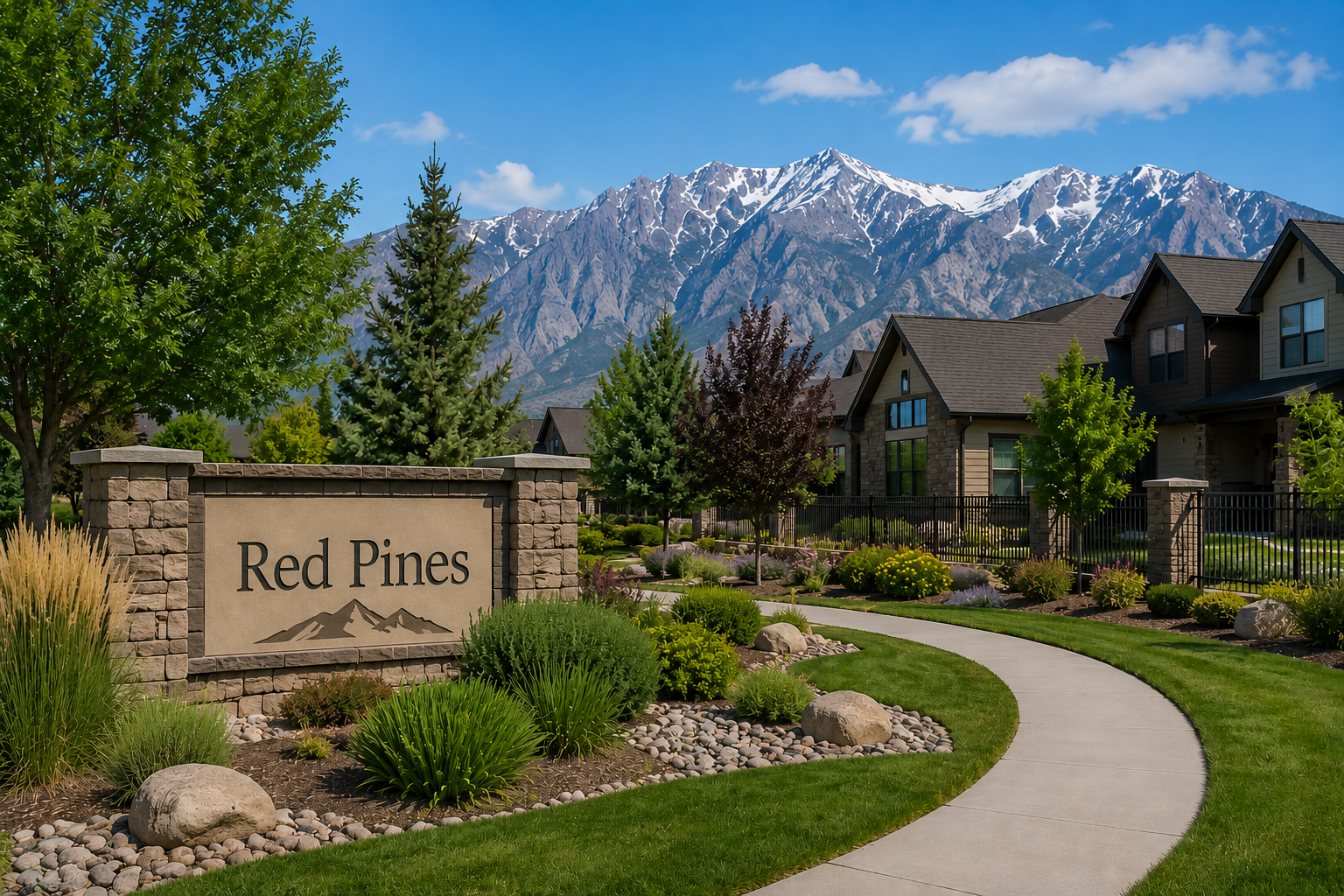
If you manage an HOA property along the Wasatch Front, Utah does not make it easy. The climate swings from brutal freeze cycles in January to scorching heat in July. The soil is alkaline and fights against ornamental plantings. Water budgets are tight in the second-driest state in the country, and utility rates climb every year. On top of all that, you need thousands of square feet of common-area landscape to look sharp, stay safe, and stay within budget.
Denkers Property Maintenance has been doing exactly that since 1984. We’ve worked with HOA boards, commercial property managers, and residential communities across Salt Lake County and Davis County for over four decades. That experience shows what works, what fails, and what quietly drains HOA budgets. More importantly, it shows what actually protects property values over the long haul.
Here are the most important lessons that 40 years of Utah HOA landscape maintenance have taught us.
The most expensive mistake we see HOA boards make is waiting until problems are visible. By the time a problem shows up, you are already behind. In Utah’s climate, being reactive turns a $500 maintenance call into a $5,000 repair.
Take irrigation systems as an example. A misaligned spray head in April wastes thousands of gallons by June. A cracked lateral line running undetected through summer creates dead zones and a water bill nobody can explain. A controller that skipped proper winterization can fail on the first warm spring day, leaving a zone running at full pressure with no output.
The same principle applies to trees, hardscaping, and turf. Utah’s freeze-thaw cycle hits multiple times in a single week during March and April. It is relentless on concrete curbing, landscape edging, and root systems. Properties that get a professional evaluation before each season catch and correct issues before they compound.
After 40 years, we are certain of this: HOAs on a proactive maintenance schedule spend far less money annually than HOAs that are not. Prevention always wins the math.
This pattern repeats itself constantly across Salt Lake and Davis counties. A developer builds a planned community and installs a landscape designed to look impressive at the sales office opening. They plant species that need far more water than Utah’s climate naturally provides. Kentucky Bluegrass, water-hungry ornamental shrubs, non-native flowering perennials — all of it spread across acres of common area that will demand intensive irrigation indefinitely.
The HOA board inherits this landscape also; they inherit a water bill that keeps growing.
Long-term HOA success almost always involves a phased move toward plants that actually belong here. Native Utah plants like blue grama grass, Apache plume, rabbitbrush, and ornamental sage are not a compromise. They are a strategic upgrade and need far less water. These plants resist the local pest pressures that hammer thirsty ornamentals. They thrive in Utah’s conditions rather than just surviving them.
This transition does not need to happen all at once. The smartest HOAs make incremental changes. They replace non-functional turf zones with decorative rock and mulch or swap out failing ornamentals for drought-tolerant natives. Some even start by convert spray irrigation zones to drip. Over time, they arrive at a landscape that looks better and costs less to maintain every single year.
Irrigation waste quietly consumes HOA operating budgets. We have watched it happen for four decades. It is still the most under-addressed issue we find on new properties. HOA boards are not ignoring it because they do not care. They miss it because irrigation inefficiency is invisible. It runs underground; it runs at 4:00 a.m. In most cases it shows up as a line item on a utility bill that everyone assumes is just the going rate.
It is not just the going rate. Most HOA irrigation systems we evaluate carry measurable waste that adds up to hundreds of dollars per month. Common problems include zones running at peak evaporation hours instead of early morning. They include overlapping spray patterns that double-water areas between heads. Broken or sunken heads broadcast water onto hardscape instead of turf. Controllers run full schedules through rainstorms and cool stretches that need no irrigation at all.
Fixing these problems does not require a full system replacement. A professional irrigation audit identifies exactly where your system wastes water and ranks repairs by impact. A smart controller upgrade, a drip conversion on ornamental zones, and properly timed programming can cut irrigation water consumption by 25 to 40 percent. Your landscape will look identical. Your water bill will not.
In a state dealing with persistent drought and rising municipal water rates, water management is one of the most direct budget levers your HOA board controls.
Click here to learn about how your HOA can cut water costs this summer.
Mature trees are the most valuable and the most dangerous assets on an HOA property. They take decades to grow. They provide shade, improve air quality, and deliver curb appeal that no new planting replaces quickly. When property managers neglect them, the consequences are serious.
We have seen it many times across this valley. A mature cottonwood that nobody pruned in years drops a major limb onto a parked car during a late-spring windstorm. A Bradford pear with a co-dominant stem — a structural defect a trained arborist would catch early — splits at the trunk under the first heavy November snow. A row of evergreens along a community fence line develops a fungal infection that spreads through the entire row before anyone notices.
Each of these scenarios carries significant liability exposure. Each one also costs far more as an emergency than it would have as a planned removal or proactive treatment.
Proactive tree care is the investment that prevents all of it. Annual inspections, crown thinning to reduce wind resistance, structural pruning on young trees, and early disease detection — these are what keep your tree canopy safe, healthy, and liability-free. The HOAs with the best-looking and safest tree canopies along the Wasatch Front are the ones that never skipped their annual tree evaluations.
HOA common areas set the first impression for every prospective buyer, every current homeowner, and every visitor who drives through. The condition of those areas sends a message. A well-maintained common area tells people the board is attentive, financially responsible, and invested in the community. A neglected one says the opposite.
What surprises most boards is how fast visible decline arrives. Turf that misses proper aeration and fertilization starts thinning and patching within a single season. Landscape beds without fresh mulch bake in the Utah summer sun, lose moisture fast, and generate weed pressure that builds week after week. Trees that go unpruned develop deadwood and irregular forms that look increasingly unkempt over time.
None of these problems announce themselves dramatically. They creep in gradually. Then one day a homeowner submits a complaint, or a real estate agent tells a seller that the common areas are affecting their listing price, and the board realizes the landscape has slipped further than anyone noticed.
Consistent professional maintenance keeps the landscape ahead of that compounding decline. Utah’s climate works against you every season. A good maintenance partner works harder.
We have watched this play out more times than we can count. An HOA board goes out to bid on its annual maintenance contract. A new company submits a number that is noticeably lower than everyone else. The board votes to switch and justifies the decision on budget grounds. Within one or two seasons, fixing what the low bidder missed — or did wrong — costs more than the board thought it was saving.
Landscape maintenance is a skilled trade. Irrigation repair requires real technical knowledge of hydraulics, pressure, and system design. Tree work requires understanding of structure, disease, and safe rigging. Turf management requires knowledge of soil chemistry, grass varieties, and seasonal timing specific to Utah’s climate and elevation. Crews without proper training and supervision produce results that show — and results that cost money to fix.
The lowest bid is rarely the best value. The best value is a contractor with a long, verifiable track record in your specific geography. One with crews that know Utah soil, Utah weather, and Utah plant material. One with the equipment and the capacity to do the work correctly the first time.
That is not a sales pitch. That is what 40 years of watching properties cycle through maintenance contractors has consistently shown us.
Since 1984, Denkers Property Maintenance has worked with HOA boards, commercial property managers, and residential communities from South Jordan and Herriman in the south to Bountiful, Layton, and Syracuse in Davis County. Here at DPM we have maintained properties through record snowfalls and record droughts. We have helped communities make the transition to water-conserving landscapes and smart irrigation technology and have watched neighborhoods grow from new developments into established communities with mature trees and decades of landscape history.
What has not changed in 40 years is this: the HOAs that invest consistently in professional landscape maintenance spend the least on emergency repairs, carry the least liability exposure, and maintain the highest property values over time.
If your HOA is looking for a maintenance partner with the local expertise and the track record to back it up, we would be glad to talk.
Text or call us today at 801-484-8389 to schedule a custom property evaluation. Whether you manage a large planned community, a commercial campus, or a mid-size HOA anywhere in Salt Lake County or Davis County — DPM is ready to put four decades of Utah landscaping experience to work for you